Carpathian Hound
The Mystery of The Invisible DogThe Carpathian Hound is a small but intricately made crystal sculpture whose transparency makes it both a prized artwork and an unusually effective hiding place. Created by Edward Niedland for Fenton Prentice, it is stolen before delivery, concealed beneath the water in a courtyard pool, recovered by the investigators, and later found in an oven. Its material properties shape the mystery: what appears to be an empty stretch of water contains the very object everyone seeks.
Commission and History
Edward Niedland made the Carpathian Hound especially for Fenton Prentice. The sculpture had been finished about a month before the theft, but Edward had not yet delivered it. He was preparing to show some of his newer work at the Mailer Gallery, and Prentice had agreed that the sculpture could be included. Its disappearance therefore interrupts both a personal commission and a planned exhibition.
Prentice regarded the work as exceptional and worried that its artistic value made it attractive to unscrupulous buyers familiar with Edward’s creations. Charles Niedland, Edward’s brother, initially treats the burglary as ordinary: he suggests that the intruder entered through a kitchen window with a glass cutter and escaped with the sculpture after police arrived. But the apparent simplicity of the entry does not explain why the thief selected this one object and left the rest behind. The sculpture’s importance to Prentice, and its possible appeal to collectors, give the theft stakes beyond the loss of a decorative item.
Form and Craftsmanship
The Carpathian Hound is made of crystal, not ordinary glass, and incorporates gold. Charles explains that crystal uses very fine silica with a high proportion of lead oxide, which makes it heavier and more brilliant than ordinary glass. Edward worked the material while it was extremely hot and nearly liquid, shaping it with tools, reheating it as it cooled, and repeating the process until he achieved the desired form. He then finished the sculpture by grinding, buffing, and polishing it with acid.
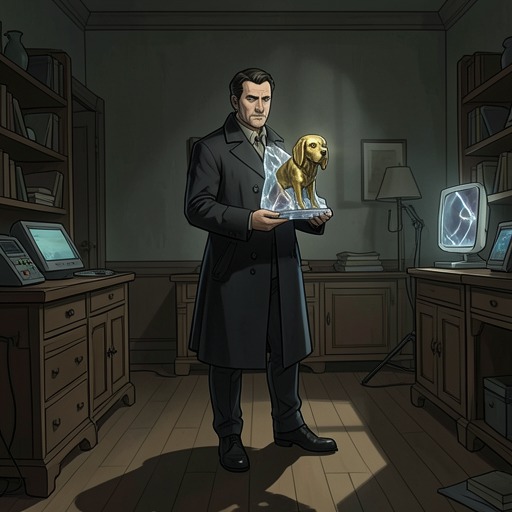
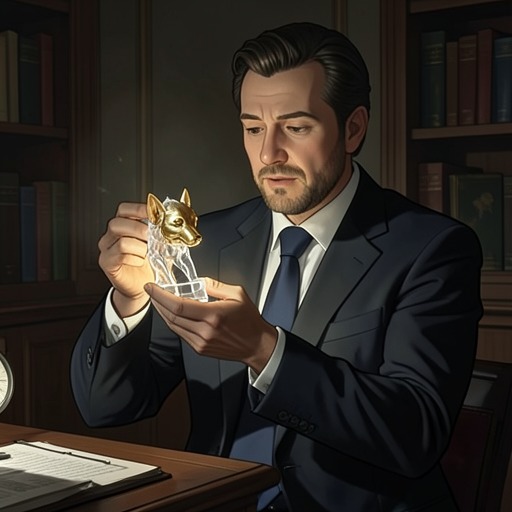
The finished figure is about six inches tall, measured from the bottom of its glass base to the tips of its ears. It depicts a heavily muscled dog with a square, massive head. Gold rims its wide, round eyes, and flecks of gold form froth on its crystal jowls. A human skull lies between its feet, while a long piece of gilt cord is tied around its middle. Those details connect the sculpture’s polished material beauty to the unsettling legend it depicts: the shining eyes recall the reported glow of the ghost dog, while the skull gives the figure a direct association with death.
The Legend Represented
The sculpture takes its subject from a tale Charles recounts about a village in the Carpathian Mountains. The villagers believed that a demon dog haunted them, though Charles characterizes the supposed creature as a legend rather than an established animal. In the story, the dog was connected to the ghost of a nobleman who had bred savage hunting dogs, said to be part wolf, and kept them half-starved to make them keen hunters.
After one dog escaped and killed a child, the child’s father demanded that the pack be destroyed. The nobleman refused and reportedly offered the father coins for the loss. The father, enraged, threw a stone that killed the nobleman, who cursed the village before he died and vowed to return. The pack was destroyed, but the tale says a huge, gaunt hound continued to roam at night, howling and unable or unwilling to eat food left for it. Its perpetual hunger echoes the nobleman’s treatment of his own dogs. In time, the villagers moved away, leaving the alleged haunting in an abandoned ruin.
This folklore gives the artwork a meaning beyond its craftsmanship: it preserves a story of violence, hunger, and the consequences of cruelty in the form of a beautiful object. The legend itself remains a human account of a feared creature, while the sculpture is a tangible, carefully worked representation of that account. Its crystal and gold make the legendary dog visible as art, even as the transparency that distinguishes the artwork later makes it difficult to see in water.
Theft and Concealment
The thief’s method depends on the sculpture’s near-invisibility. Rather than carrying it away from the pool, the burglar lowers it on its gilt cord until it touches the bottom, then lets go. Against the pool’s random pattern of blue and gold tiles, the cord is difficult to distinguish; the transparent sculpture blends into the water and its surroundings. The object is not hidden in a sealed container or removed from the building. It is left exposed, in a place where the investigators can search without recognizing what is present.
The Three Investigators connect that concealment to the search for an object hidden in plain sight. Jupiter Jones uses a glass knife in a water pitcher as an example of how a transparent object can seem to disappear, and Bob Andrews realizes that the pool is the likely hiding place. When Jupiter retrieves the sculpture, Fenton Prentice turns it over in his hands and recognizes the crystal dog by its distinctive shape and gold details. The discovery resolves the apparent contradiction at the center of the search: the sculpture was visible in the pool, but its material made visibility insufficient for recognition.
Recovery and Significance
The recovery does not end the sculpture’s journey. During a later watch, the investigators see a person reach into the pool and close a hand around the transparent object. The figure surfaces, leaves, and is subsequently connected to Sonny Elmquist. When Prentice opens the kitchen oven, the Carpathian Hound is inside with the gilt cord wrapped around it. Jupiter concludes that Sonny is not the burglar: Sonny had thought Prentice might reward him for finding the sculpture and did not know about the ten-thousand-dollar ransom. He had encountered it while wandering in his sleep.
The sculpture therefore passes through distinct forms of concealment: first stolen from Prentice, then submerged where its transparency disguises it, and later recovered from the pool and found in the oven. Each change in location alters who can see or understand it without changing the object itself. Its physical clarity produces practical obscurity, while its gold eyes and carefully finished surface make it unmistakable once it is held and examined. As the mystery’s central object, the Carpathian Hound joins Edward’s artistic legacy, the village legend, the burglar’s ingenuity, and the investigators’ solution in a single, recoverable work.